|
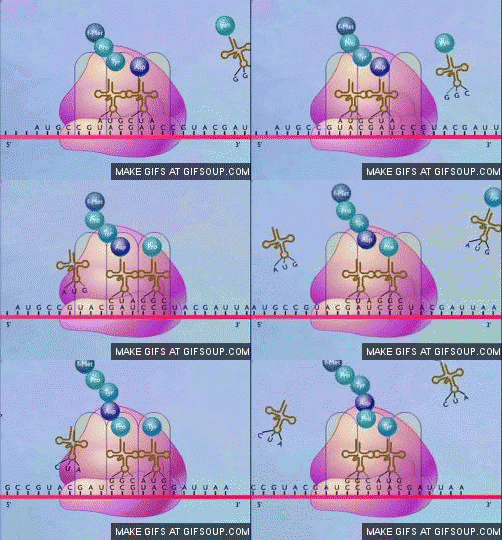
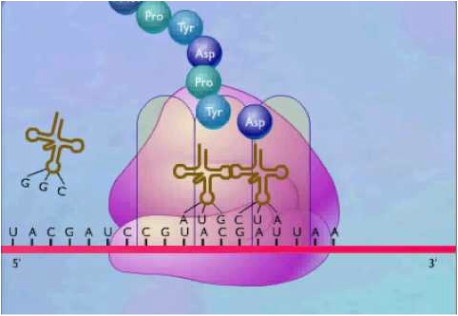
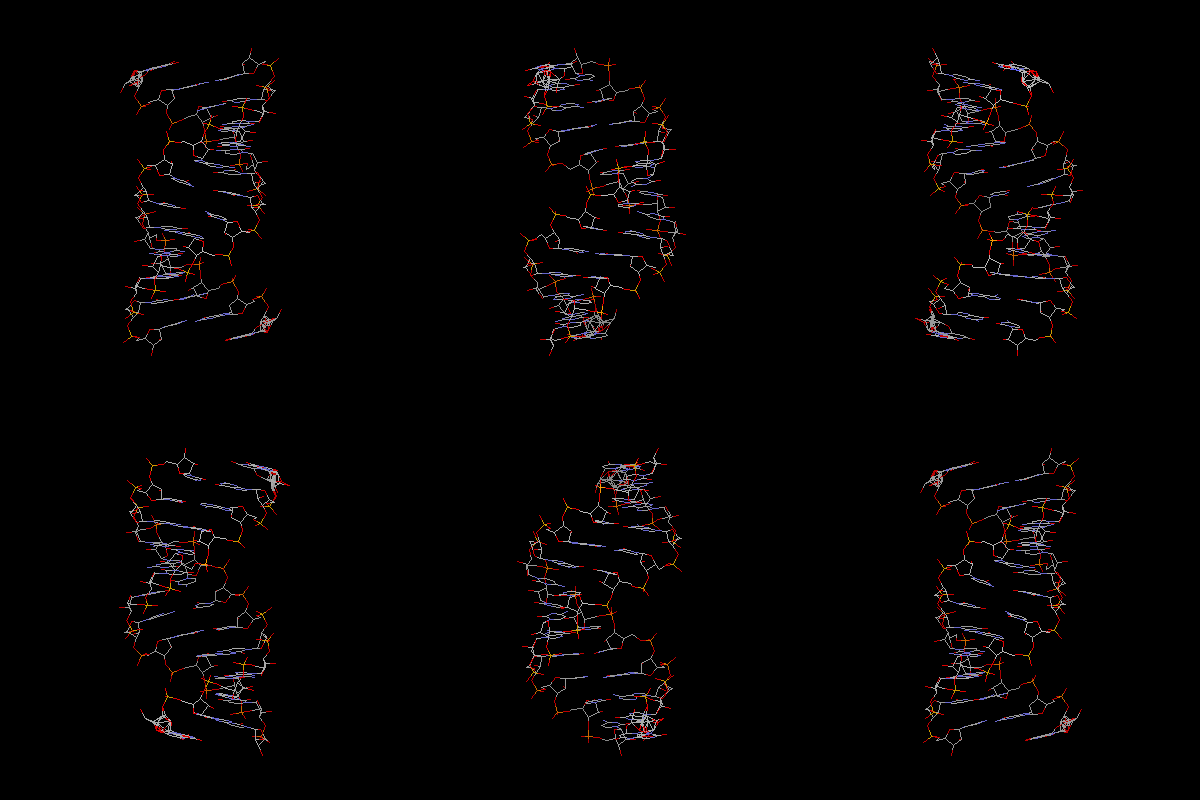
This video shows RNA transcription in much more detail. Some of the things you should notice is that the entire sequence of DNA is not transcribed, only one small part. That small part is one gene. The blue-ish molecule that races along the DNA is RNA polymerase. As it races along the DNA you can see it briefly separating the 2 DNA stands and then leaves behind a single stranded RNA molecule; you can even see the RNA nucleotides being drawn into the process. At the end of the gene (at the end of transcription) the RNA is released to eventually make its way out of the nucleus. This video is a "sequel" of a previous video that featured transcription of DNA into RNA, specifically mRNA. In this video a ribosome translates the mRNA base sequence into a sequence of amino acids to make a protein. Again, there is more detail in this video than you are expected to understand, but this video is pretty true to what happens. It starts with the mRNA leaving the nucleus. From there, the ribosome (which is actually made of two subunits), combine and attach to the mRNA (yellow strand) at what would be the start codon. From there is reads the mRNA in groups of 3 (codons). At each codon a tRNA (green) brings into the ribosome an amino acid (red). The tRNA connects its amino acid to the growing chain of amino acids and departs the ribosome. The chain of amino acids grow and can be seen extending from the ribosome as a red string. Inside the ribsome you can briefly see that tRNA attaching to the mRNA's codon with its anticodon. This is where the amino acid is connected to the amino acid chain. Eventually the ribosome will reach a stop codon. There the amino acid chain is released. The amino acid chain clumps together to create the protein. Remember, proteins are important because proteins are used in every feature and function in life. Some proteins are used in an organism's structure (for us in our skin, our muscle, hair, etc.), some enzymes are used as channels through the cell membrane performing either facilitated diffusion or active transport, some enzymes are used as enzymes, controlling the reactions that occur in our cells, while other proteins have other purposes. All in all, everything in life involves proteins. These proteins are made in translation of mRNA to an amino acid chain.
Students used candy to model the structure of DNA & RNA. The Candy DNA was made in a previous activity. They were expected to create an assigned sequence of RNA nucleotides from their already created DNA strand.
In DNA, each nucleotide consists of a deoxyribose (red licorice), a phosphate (marshmallow), and a nitrogenous base (Skittle). It is important that the deoxyribose and phosphates make up the back-bone and that the bases are bound to the deoxyribose. In RNA, each nucleotide consists of a ribose (black licorice), a phosphate (marshmallow), and a nitrogenous base (Skittle). It is important that the deoxyribose and phosphates make up the back-bone and that the bases are bound to the deoxyribose. The Skittle bases are as follows:
Based on the original stand of DNA, the complimentary strand of RNA was created using the correct base pairs: G to C, C to G, T to A, A to U, the U replacing the T in RNA. Unit 4: Genetics & Heredity 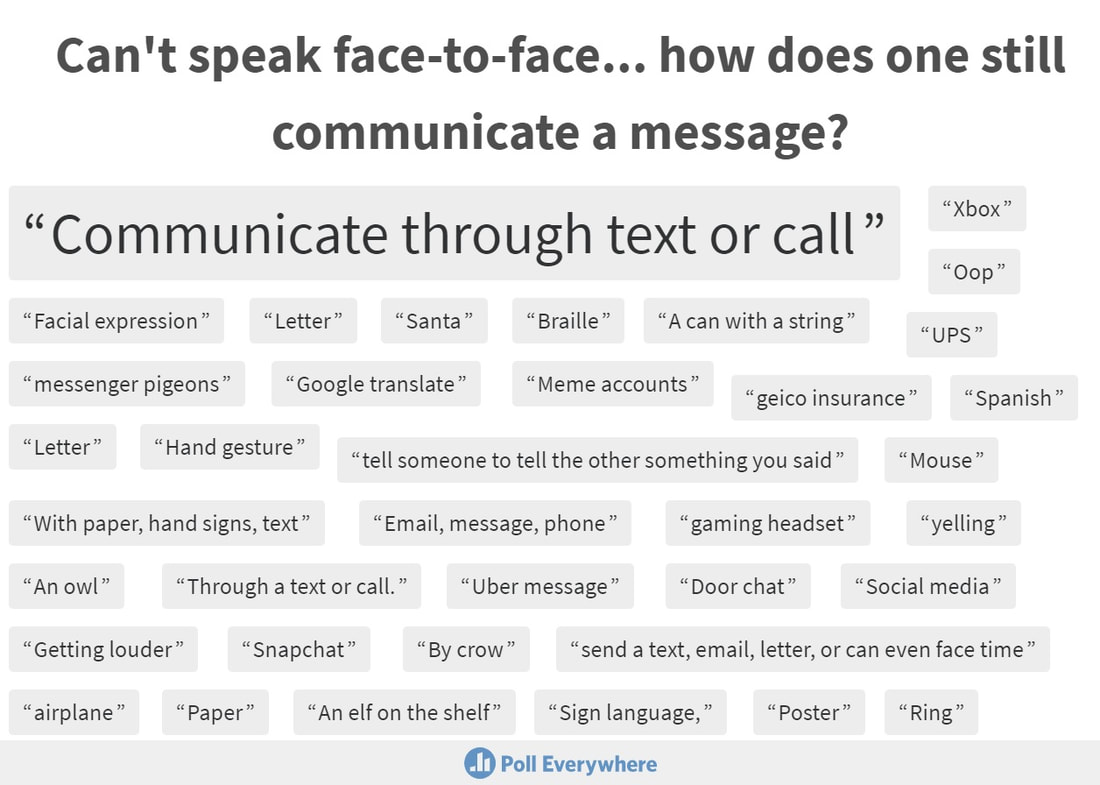 DNA is in the nucleus and carries the instructions to make proteins (amino acid sequences) in its sequence of bases (ATGC's). The ribosomes in the cytoplasm need the instructions to make specific proteins, but the DNA is too large a molecule to leave the nucleus and cannot give the "message" to the ribosomes directly. DNA will transcribe its message into smaller pieces of RNA which can leave the nucleus and deliver the instructions ("message") to the ribosomes.
Above are student responses to the analogy of two people needing to communicate while not being able to speak face-to-face. For starters, here is the study guide: Here is a screen-shot of the in-class review: 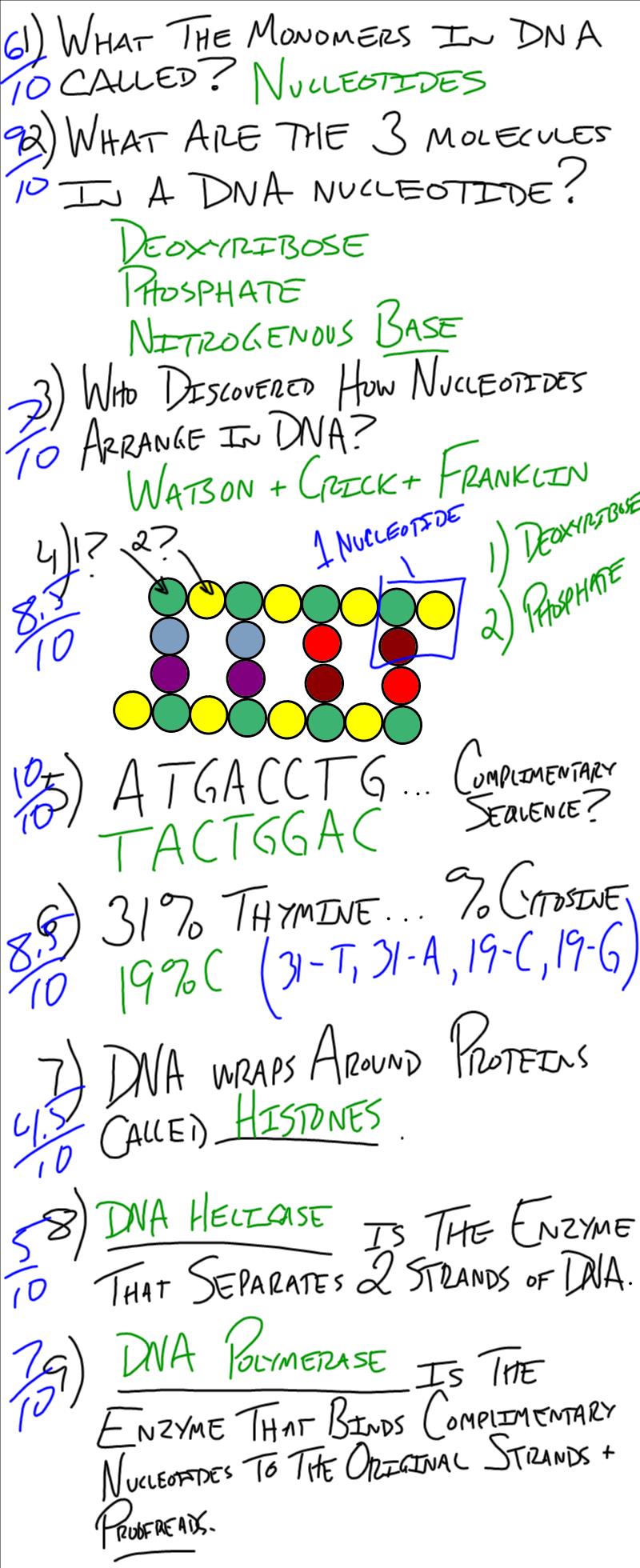 Here are the online lessons:
Don't forget your notes: Here are copies of notes provided by your peers: Here are previous blog entries:
Play the Kahoot! HERE Unit 4: Genetics & Heredity Students used candy to model the structure of DNA. They were expected to create an assigned sequence of DNA nucleotides and then likewise create the complimentary DNA strand.
In DNA, each nucleotide consists of a deoxyribose (red licorice), a phosphate (marshmallow), and a nitrogenous base (Skittle). It is important that the deoxyribose and phosphates make up the back-bone and that the bases are bound to the deoxyribose. The Skittle bases are as follows:
Based on the original stand of DNA, the complimentary strand of DNA was created using the correct base pairs: G to C, C to G, T to A, A to T. In this example, the students were assigned the sequence CAGCA and determined the complimentary sequence GTCGT. The original DNA strand (left side) was glued in place for a later activity (transcription). Unit 4: Genetics & Heredity 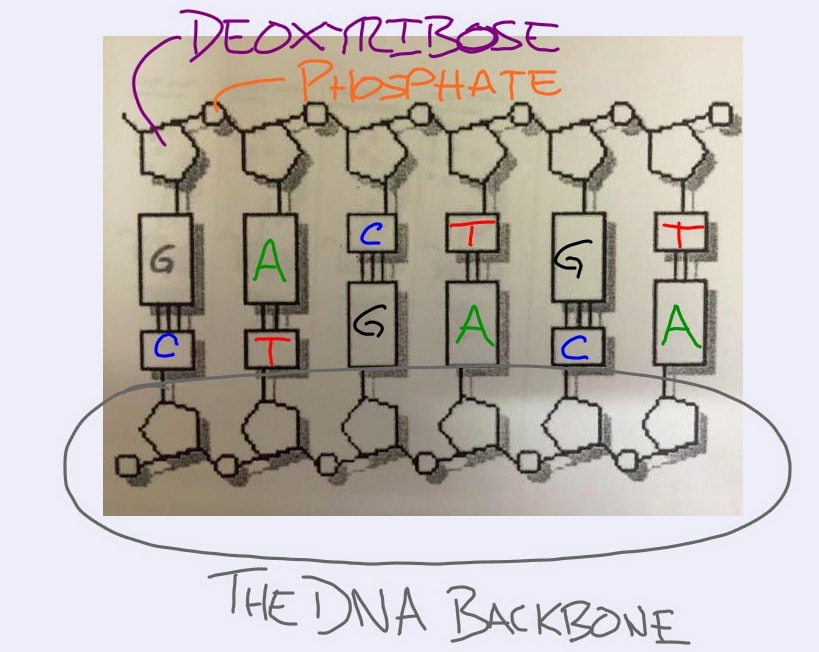 Please note the following:
Unit 4: Genetics & Heredity |
Current Unit (Biology)Prepare for your next assessment...Schoology

MCAS Countdown
Mr. Dubuque's
|

|

|

|
Biology Calendar

STEM9 Calendar

Fellow Teachers
Categories
All
#BioDub
#ChemistryOfLife
#ClassActivity
#Ecology
#EvolutionBiodiversity
#GeneticsHeredity
#GIF
#Homework
#HumanAnatomy
#IntroToBio
#Lab
#LifeCellsNRG
#Links
#MTFEMCAS
#Outbreak
#Review
#SOTM
#SOTW
#STEM9
#torssweater
#Video

 RSS Feed